
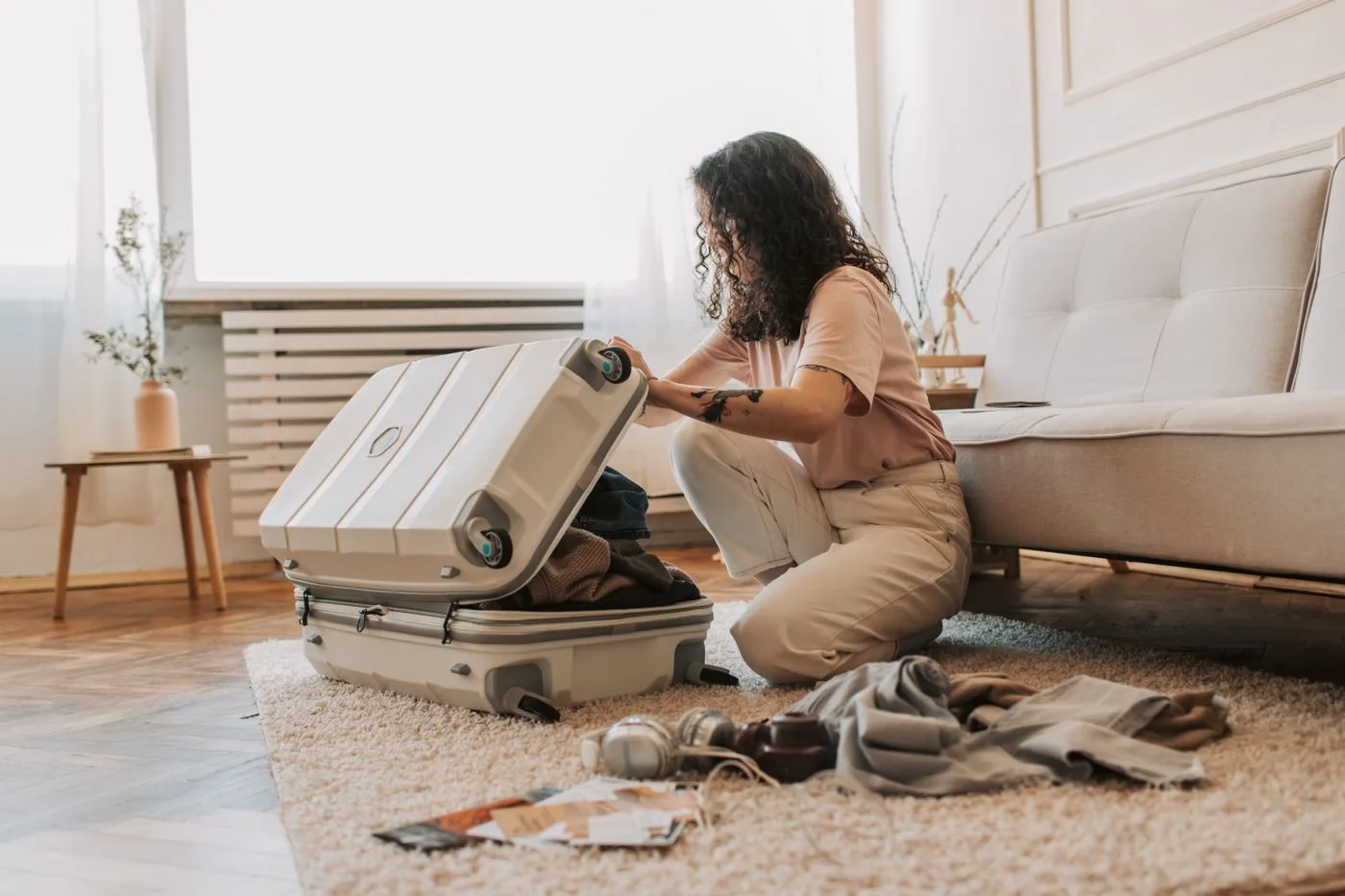
A suitcase can fit the transport allowance and still be frustrating in a small room. Some cases need a wide clear floor area because both halves hold clothing. Others open mainly through a lid. Before choosing by appearance, imagine reaching a change of clothes in the kind of accommodation you normally book.
Draw the opening space
Measure the closed case, then consider the area it occupies fully open. Include the space needed for you to stand or kneel beside it. A room with a narrow route between the bed and wardrobe may accommodate an upright case but offer nowhere sensible to spread two loaded halves. Do not plan to use the bed if that would put dirty wheels or wet outer fabric against bedding.
An available luggage rack may help, but check what it supports and how the case opens on it. A rack shown in a hotel photograph does not establish the equipment in every room category. Ask about a feature that genuinely affects your stay, or choose luggage you can use without relying on that particular furnishing.
Try a real retrieval
Pack the candidate arrangement with representative clothing and toiletries. Open it only as far as a modest room would allow. Can you remove a shirt without releasing the contents of the other half? Does a divider need to lie flat on the floor? Can the lid remain supported without leaning against a wall or hanging from its hinge?
The exercise is about access rather than speed. A case that opens widely may be excellent when you unpack fully into a wardrobe. The same design can be awkward for repeated one-night stops. Compare that pattern with the split hotel stay decision, because changing rooms creates more unpacking transitions than the destination list suggests.
Consider what stays inside
Separate the possessions you normally remove immediately from those you leave packed. A toiletry bag and first outfit should not require rebuilding the entire interior. If your case has a narrow lid compartment, check whether its actual depth suits the contents rather than assigning it a purpose from its photograph.
A top-opening arrangement is not automatically the answer. Deep main compartments can hide items at the bottom, and an overfilled lid may still need support. The packing cube decision can help organise depth, provided the cubes fit the case instead of creating unused gaps or extra bulk.
Choose through the recurring room
If most trips involve spacious accommodation and full unpacking, a broad opening may be entirely comfortable. If you regularly stay in compact rooms, access from a smaller footprint may matter more than a fashionable shell. Keep transport requirements, lifting, handles and repairability in the comparison as well; room access is one criterion within the whole journey.
What if the case you own is awkward? Set a small arrival pouch near the opening and unpack the next day's items at the first suitable opportunity. Improving retrieval may resolve the inconvenience without replacing sound luggage. Buy a different shape only when the recurring limitation is clear enough to test against it.


